
Gas-Assist Molding: How It Works and When to Use It
Key Takeaways
- Gas-assist molding fills the mold cavity to approximately 90 percent with molten plastic, then injects nitrogen into the molten core to displace resin and form hollow channels.
- The nitrogen does not mix with the plastic and follows the path of least resistance through the hottest, thickest material in the part.
- Gas pressure packs the melt against the cavity wall through cooling, which is what eliminates sink marks over thick ribs and bosses.
- Gas-assist produces a consistent surface color with no swirl pattern, which is the main finish difference from structural foam molding.
- Structural foam uses a blowing agent or nitrogen mixed into the resin to foam the entire wall section, while gas-assist keeps the wall solid and hollows only the channels the tool is designed for.
- Gas-assist works best on parts with deliberately thick sections, and it is a poor fit for uniformly thin walls where the gas has nowhere predictable to travel.
- Gas channels have to be designed into the part and the tool. Converting an existing solid part to gas-assist can work well providing gas channels are added at the appropriate locations.
- 20/20 Custom Molded Plastics runs gas-assist alongside structural foam, structural web, and high-pressure injection molding across three plants in Holiday City, Ohio; Bluffton, Indiana; and Covington, Georgia.
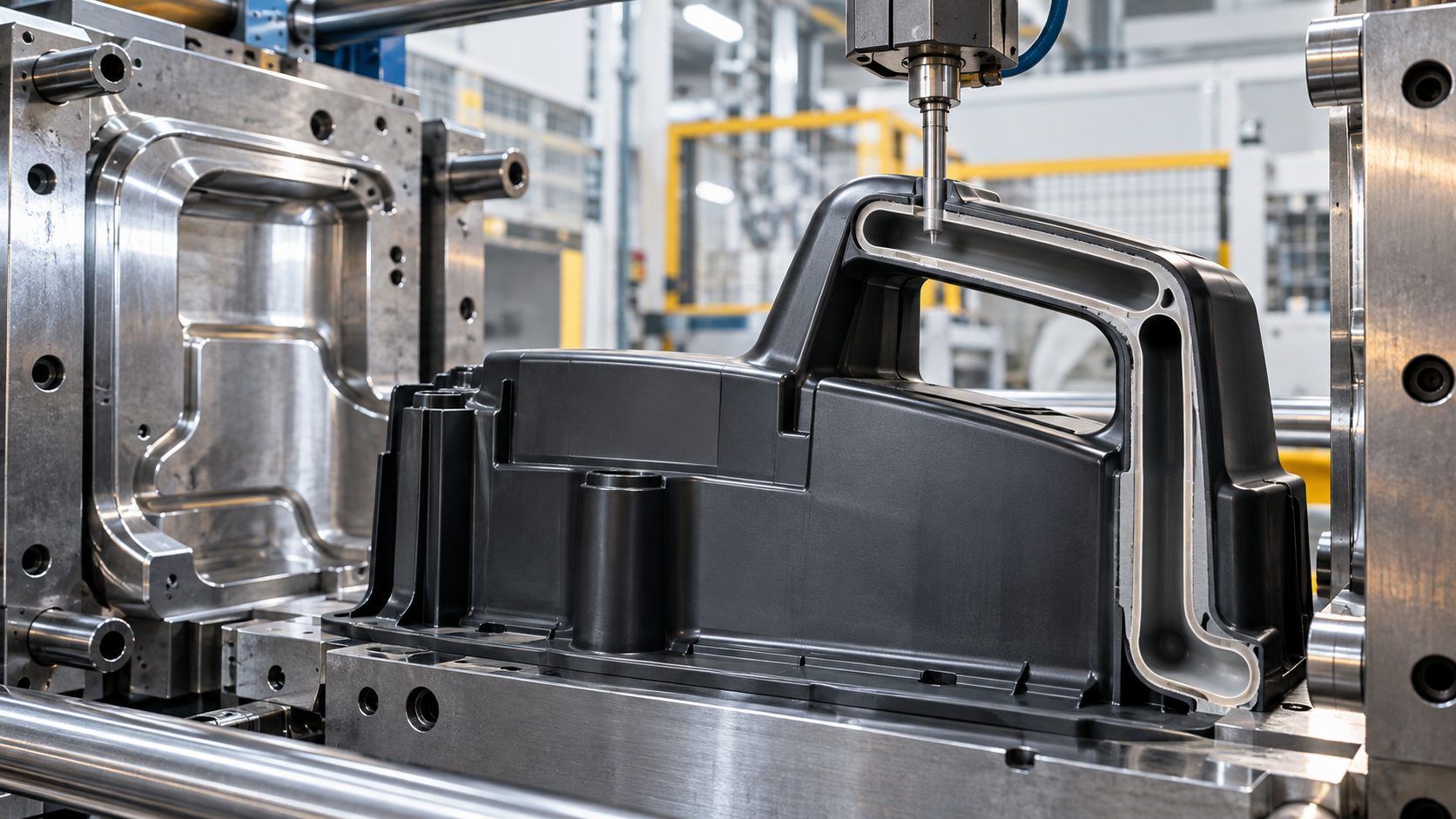
Gas-assist molding is an injection molding process that fills the mold partway with plastic, then pushes pressurized nitrogen into the still-molten core to hollow out the thickest sections of the part. The gas holds the plastic against the mold wall while it cools, which removes sink marks, cuts weight, and keeps large parts flat. It is one of the low-pressure processes 20/20 Custom Molded Plastics runs for big parts that need a clean surface.
If your part has heavy ribs, thick handles, or a mix of thin and thick walls, this is usually the process someone will bring up. Here is what actually happens inside the mold, where gas-assist beats structural foam, and the design questions worth settling before you commit to a tool.
How the gas-assist molding process works
The cycle starts the same way any injection molding cycle does. The difference is what happens after the first shot of plastic.
- Partial fill. Molten plastic is injected into the cavity, but only partway. A typical short shot fills somewhere in the range of 90 percent of the cavity volume. Exactly how short depends on the part.
- Gas injection. Pressurized nitrogen enters through gas pins built into the tool, or through the nozzle, and pushes into the core of the melt while the outer skin is already freezing against the cold steel or aluminum.
- Channel formation. The gas does not mix with the plastic. It takes the path of least resistance, which is the hottest and least viscous material, meaning the thick ribs and heavy sections. As it travels it displaces that resin outward and drives it into the extremities of the mold.
- Packing and cooling. The gas holds internal pressure against the inside of the part for the rest of the cooling phase. That is what keeps the plastic pressed tight to the cavity wall instead of shrinking away from it.
- Venting and ejection. The gas is vented off before the mold opens, and the part comes out with hollow channels running through what used to be its heaviest sections.
The important mental shift is that the gas replaces the packing pressure a conventional press would apply with the screw. That is why gas-assist belongs to the low-pressure family alongside structural foam and structural web, and why it needs less clamp tonnage than high-pressure injection molding for the same part footprint.
What gas-assist does to the part
- No sink marks over thick sections. Internal gas pressure holds the surface out while the part cools, so deep ribs, heavy bosses, and thick transitions come out clean instead of sinking in.
- Less warp and lower molded-in stress. Because the machine is not packing the cavity out at high pressure, less stress gets frozen into the part, and big panels stay flatter.
- Lower part weight and less resin. Every hollow channel is material you did not buy. How much you save depends on how much of the part is genuinely thick section.
- Shorter cooling time. Cooling is usually the longest phase of the cycle, and it is driven by the thickest wall in the part. Hollowing those sections takes time out of every cycle.
- A smoother surface than foam. Gas-assist gives a consistent surface color and finish with no swirl, which is the main reason it gets specified over structural foam on visible parts.
- Bigger parts on smaller presses. Lower cavity pressure means maximum part size with minimum clamp tonnage, the same economics that make the rest of the structural web and gas assist family attractive for large components.
Gas-assist vs. structural foam: what actually differs
Both are low-pressure processes aimed at large parts, and they get confused constantly. The difference is where the gas comes from and where it ends up.
Structural foam molding mixes a blowing agent or nitrogen into the resin before it ever enters the mold. That agent expands throughout the wall section and leaves a cellular core sandwiched between two solid skins. The whole wall is foamed. The trade-off is a visible surface swirl, caused by small bubbles breaking at the skin as the part fills.
Gas-assist introduces nitrogen separately, after the plastic is already in the cavity. The gas stays in defined channels. The rest of the wall stays solid, and the surface never gets the swirl pattern because nothing is foaming at the skin.
That leads to a straightforward split:
- Choose structural foam when you need overall stiffness across a large footprint, thick walls throughout, and the lowest weight for the rigidity, and an industrial finish is acceptable.
- Choose gas-assist when surface appearance matters, when the thick sections are localized in ribs and handles rather than spread across the whole part, or when you need to pull weight out of specific heavy areas.
If you are still deciding between the broader process families, the comparison of low-pressure and high-pressure injection molding covers the wider picture.
When gas-assist is the right call
Gas-assist earns its place when the part has deliberate thick sections. Good candidates include:
- Parts with heavy structural ribs, thick bosses, or integrated handles
- Large panels, covers, and housings where an improved surface finish is required
- Geometries that mix thin walls with thick load-bearing members
- Existing designs carrying more material than they need in localized areas
- Frames and supports where stiffness comes from section depth rather than wall thickness
When it is not the right call
- Uniformly thin-walled parts. If the entire part is thin, roughly under an eighth of an inch, the gas has no predictable channel to follow and the hollow sections come out inconsistent.
- Parts with no room for channels. The gas path has to live somewhere. If the geometry cannot accommodate a rib or a thickened rail to carry it, the process does not have much to work with.
- Straight conversions of existing solid parts. Taking a part designed for conventional molding and running it as gas-assist without redesign has a low success rate. The channel layout has to be part of the design, not an afterthought.
- Very long or highly complex flow paths. Complicated fill patterns make the gas path hard to predict and control.
Designing a part for gas-assist
A few decisions do most of the work:
- Design the channel, do not retrofit it. Ribs and thickened rails become the gas routes. Lay them out as a connected network rather than isolated features.
- Be deliberate about wall thickness. Thin nominal walls form the skin and cool fast. Thick sections are where you want the gas to go. A part with no thickness contrast gives the gas no direction.
- Gate and gas pin placement are paramount to being successful. Where resin enters and where nitrogen enters together determine which sections hollow out and how far the channel runs.
- Plan for process validation. Gas volume, pressure, delay timing, and hold time all get dialed in during first article runs. Build that into the schedule.
- Get molder feedback before the tool is cut. The cheapest time to fix a gas channel layout is on the screen. 20/20 Custom Molded Plastics provides design-for-manufacturability feedback on wall thickness, ribs, draft, and gating before tooling is committed.
Where gas-assist sits among the other processes
Gas-assist is one option in a family. Conventional high-pressure molding handles smaller, detailed, thin-walled parts. Structural foam handles large, thick, rigid parts. Structural web sits close to foam and produces a firmer, smoother surface on big panels and covers. Gas-assist targets thick localized sections and surface quality. Our overview of the types of injection molding maps the full set if you want the wider comparison.
The practical advantage of working with a molder that runs more than one of these processes is that your part gets matched to the right process instead of forced into the only one available.
Running gas-assist at 20/20 Custom Molded Plastics
Large parts need press size, platen size, plant space, and process experience in the same building. We run gas-assist alongside structural foam, structural web, and high-pressure injection molding, with multi-nozzle capability for filling large geometries evenly, across plants in Holiday City, Ohio; Bluffton, Indiana; and Covington, Georgia. We work with custom and recycled material blends, and we handle assembly, machining, labeling, packaging, storage, and drop-ship so parts arrive ready to use.
Talk through your part
If you have a part with heavy sections, a surface finish requirement, or a weight target you are not hitting, send us the design. Our engineers will review the geometry, tell you whether gas-assist, structural foam, structural web, or high-pressure molding is the better fit, and put together a molding quote. Contact 20/20 Custom Molded Plastics to get started.