
Structural Foam Plastic Pallets vs. Wood and Steel
Key Takeaways
- Pallet economics are a cost-per-trip question, not a purchase-price question, because the purchase price gets divided across every trip the pallet survives.
- Wood pallets carry the lowest unit price and can be repaired board by board, which makes them hard to beat in open-loop lanes where pallets do not come back.
- Wood packaging used for international shipping falls under ISPM 15 and must be heat treated or fumigated and marked, a cost that repeats across borders.
- Plastic pallets are not solid wood packaging material and therefore fall outside ISPM 15 treatment requirements, which simplifies export lanes.
- Steel pallets deliver the highest load capacity and will not burn, but they are the heaviest and most expensive option and can corrode wherever the protective coating is damaged.
- Structural foam molding gives a pallet with thick ribs and heavy sections without sink marks, producing high stiffness for the weight in a single molded piece with no fasteners.
- Molded plastic pallets hold consistent dimensions run after run, which matters in conveyor lines, automated storage systems, and robotic palletizers where wood variance causes jams.
- Custom tooling pays off when the footprint is non-standard, the pallet is part of a returnable shipping system, or molded-in features replace secondary assembly.
- 20/20 Custom Molded Plastics molds structural foam pallets, bulk bins, dunnage, and returnable containers at three plants in Holiday City, Ohio; Bluffton, Indiana; and Covington, Georgia.
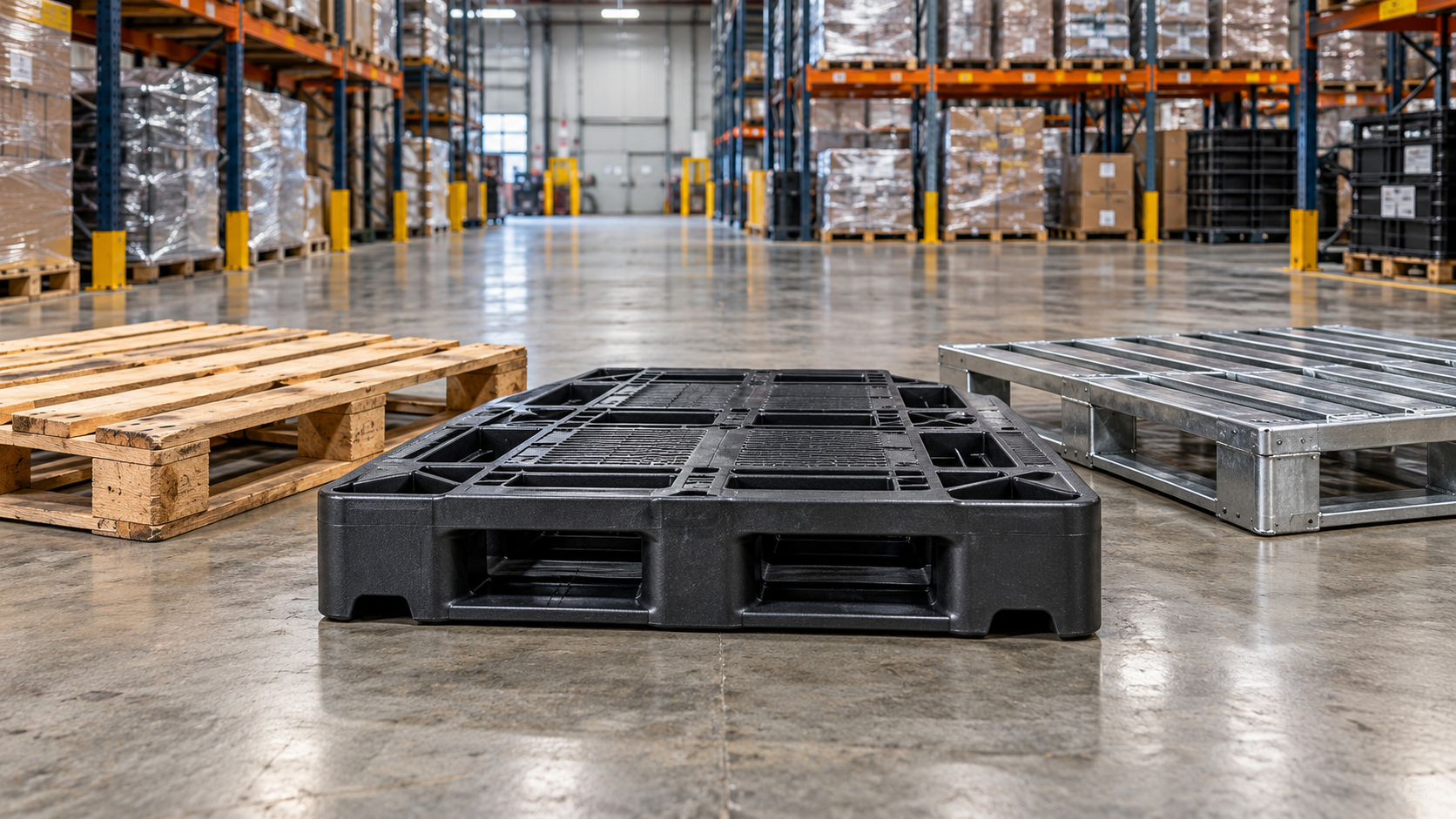
A structural foam plastic pallet costs more than a wood pallet on day one and usually less per trip over its life. Wood is the cheapest to buy and the easiest to repair. Steel carries the heaviest loads and shrugs off the most abuse. Structural foam plastic lands between them on price and tends to win in closed-loop systems, wash-down environments, export lanes, and automated warehouses where dimensional consistency matters more than replacement cost.
20/20 Custom Molded Plastics molds pallets and other material handling parts, so this is the comparison that comes up on most sourcing calls. Here is how the three materials actually stack up, and when a custom molded pallet is worth the tooling investment.
Start with cost per trip, not price per pallet
The sticker price is the least useful number in this comparison. What actually determines cost is the purchase price spread across the number of trips the pallet completes, plus everything that happens along the way.
The full picture includes:
- Purchase price divided by service life. A cheaper pallet that lasts a fraction as long is not automatically cheaper.
- Repair and inspection labor. Wood gets repaired, which is an advantage, but repair is labor you pay for.
- Product damage. Splinters, protruding nails, and broken deck boards damage packaging and product.
- Freight. Pallet weight consumes payload on every shipment, and on weight-based lanes that shows up directly.
- Compliance. Export treatment, food safety requirements, and audit documentation all carry cost.
- Downtime. A pallet that jams an automated conveyor or an AS/RS crane costs more in stopped throughput than it ever cost to buy.
Run the numbers on those six lines and the ranking often flips from what the quote sheet suggests.
Wood pallets
Wood remains the default for good reasons.
Where wood wins:
- Lowest unit cost and the widest availability anywhere in North America
- Repairable with basic tools, board by board, which extends usable life cheaply
- High static load capacity for the price
- Easy to recycle, remanufacture, or grind at end of life
- No tooling investment and no minimum order tied to a mold
Where wood struggles:
- Moisture. Wood absorbs water, which changes its weight, invites mold, and weakens the structure.
- Contamination risk. Porous surfaces, nails, and fasteners make wood difficult to sanitize for food, pharmaceutical, and clean-environment handling.
- Dimensional variance. Board thickness and overall dimensions vary from pallet to pallet, which is exactly what automated equipment does not tolerate.
- Export treatment. Solid wood packaging material used in international trade falls under ISPM 15 and requires heat treatment or fumigation plus a compliance mark, a cost that recurs on every lane.
- Handling hazards. Splinters and loose nails injure workers and shred stretch wrap and cartons.
Steel pallets
Steel is the specialty option, and when it is right, nothing else works.
Where steel wins:
- The highest load capacity of the three, suited to heavy machinery, castings, coils, and raw stock
- Will not burn, which matters where flammable materials or strict fire codes are in play
- Holds up across temperature extremes without losing structural integrity
- Non-porous and easy to sanitize
- Very long service life, and repairable by welding
Where steel struggles:
- Weight. Steel is by far the heaviest option. That eats freight payload and makes manual handling harder and slower.
- Purchase cost. Steel carries the highest upfront price of the three materials.
- Corrosion. Powder coating and galvanizing help, but once the coating is breached, steel rusts. Wet or chemically aggressive environments accelerate it.
- Ongoing maintenance. Corrosion treatment and coating repair are recurring costs that plastic and wood do not have.
Structural foam plastic pallets
Plastic pallets are not all the same, and the molding process matters. A structural foam molded pallet has a solid outer skin over a foamed cellular core. That structure is what lets the part carry thick ribs, deep sections, and heavy load-bearing members without the sink marks that thick walls cause in conventional molding.
Where structural foam plastic wins:
- Stiffness for the weight. The solid skin and foamed core work a bit like an I-beam, giving rigidity without the mass, and 20/20 Custom Molded Plastics typically sees parts come out 10 to 20 percent lighter than the same part molded solid.
- No moisture absorption. Plastic does not swell, rot, harbor mold, or change weight in a wet environment.
- Washable and non-porous. Pallets can be cleaned and sanitized, which is what makes them viable in food, pharmaceutical, and clean-handling operations.
- Export simplicity. Plastic pallets are not solid wood packaging material, so they sit outside ISPM 15 treatment requirements.
- Consistent dimensions. Every pallet out of the same tool matches the last one, which is what conveyor systems and robotic handling need.
- One piece, no fasteners. Nothing to work loose, nothing to protrude, nothing to snag product or people.
- Molded-in features. Anti-slip surfaces, label recesses, RFID pockets, drainage, and stacking geometry can be built into the mold instead of added later.
- Recycled content fits. The thicker walls and lower pressure of the structural foam process are relatively tolerant of recycled resin, so post-consumer and post-industrial material can often be used.
- When the useful life of the plastic pallet is over, the pallet can be recycled.
Where structural foam plastic struggles:
- Tooling investment. A molded pallet requires a mold, and that is a real upfront capital line. The math depends on volume.
- Limited field repair. A damaged plastic pallet generally gets reground and remolded rather than fixed on the dock.
- Open-loop losses. If pallets leave and do not come back, the higher unit cost never has a chance to amortize across trips.
- Load rating drives cost. Higher racking and dynamic load requirements mean more material and more structure, and the price follows.
- Plastic pallets can be designed to be nestable for many applications to allow reduced cost of return by getting more pallets on a load.
More on the underlying process advantages is in our post on why structural foam wins for large, heavy-duty parts.
How to choose between the three
The decision usually comes down to five questions:
- Do your pallets come back? Closed-loop systems favor plastic and steel because the cost spreads across many trips. Open-loop, one-way shipping favors wood.
- How heavy is the load? Very heavy, concentrated, or sharp-edged loads point toward steel. Most palletized freight sits comfortably in wood or plastic territory.
- Does the pallet get washed, or touch food or pharma product? That points to plastic or steel, and usually plastic for weight and handling.
- Does it run through automation? Conveyors, AS/RS, and robotic palletizers want the dimensional repeatability that molded plastic provides.
- Does it cross borders? Regular international shipping makes the ISPM 15 treatment cost on wood a recurring line item that plastic avoids.
When a custom molded pallet beats an off-the-shelf one
Stock plastic pallets are a real option and often the right one. Custom tooling makes sense when something about the application does not fit a catalog part:
- A non-standard footprint. Your product, rack, or container does not sit properly on a 48 by 40.
- The pallet is part of the product. Returnable shipping systems where the pallet, container, and dunnage are designed as one system.
- A specific equipment interface. Rack profiles, conveyor rails, or automated handling geometry that a generic pallet does not match.
- Features worth molding in. Anything you would otherwise add in a secondary operation, from RFID pockets to drainage channels to branded surfaces.
- Volume that justifies the tool. Once annual volume is real, tooling amortizes and the per-unit economics move in your favor.
What to settle before you tool a pallet
- Three different load numbers. Static load, dynamic load, and racking load are separate requirements, and the racking number usually drives the design.
- Loop type and expected trip count. This decides the entire business case, so nail it down before anything else.
- Environment. Wash-down chemistry, freezer exposure, outdoor UV, and temperature range all affect resin selection.
- Resin and recycled content. Requirements for virgin material, regrind percentage, or a specific resin family should be settled early.
- Stacking and nesting. Empty return density is a real cost, and nesting geometry has to be designed in, not added later.
- Wall thickness and ribbing. Structural foam runs walls from roughly 0.180 inches up to 0.500 inches, with 0.250 inches a common nominal, and deep ribs are where the stiffness comes from.
The cheapest time to catch any of these is before the tool is cut. We provide design-for-manufacturability feedback on wall thickness, ribs, draft, and gating up front.
Molding pallets and material handling parts with 20/20
Pallets are one of the material handling product lines we run, alongside bulk bins, dunnage, returnable containers, and shelving. Our low-pressure structural foam capability is built for exactly this kind of part: large, rugged, thick-walled, and expected to survive repeated forklift and load impacts. We run multi-nozzle presses for filling large geometries evenly, work with custom and recycled material blends, and handle assembly, labeling, packaging, storage, and drop-ship so pallets arrive ready to put into service.
Talk through your pallet program
If you are weighing a switch from wood or steel, or looking at whether a custom molded pallet beats the catalog part you are buying today, send us the requirements. Our engineers will review the loads and geometry, flag anything worth adjusting, and put together a molding quote. Contact 20/20 Custom Molded Plastics to get started.